
What should a logistics company website include? Notes from six projects
Which fields does a quote form need, what are a CBM calculator and an Incoterms guide for, and what should the panel manage? Practical notes from six logistics sites.
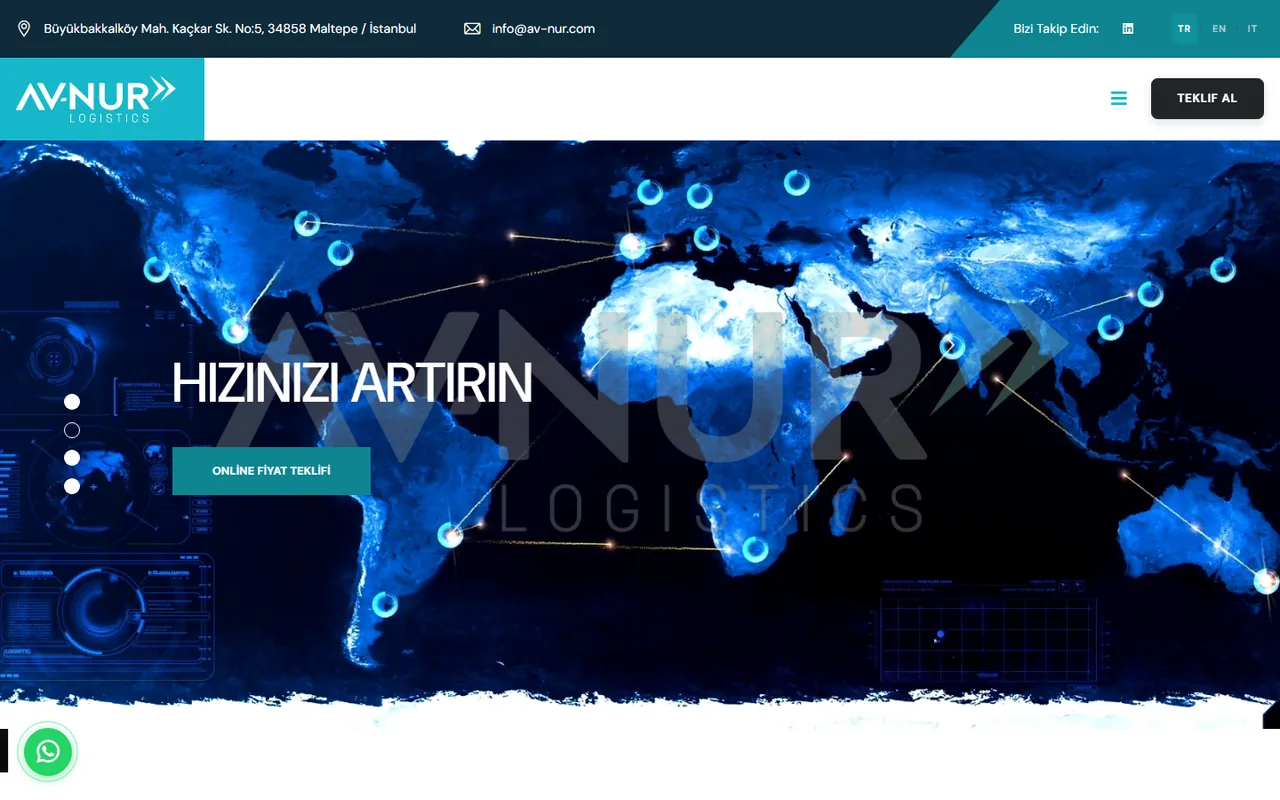
A logistics company's website does a different job from the websites of many other industries. Visitors usually don't come to get to know the company; they come to find out whether it can move a particular load and to get a price, and some of them are abroad and don't speak Turkish. I'm Berke Özyaşar, and I have built many corporate websites for client companies in freight, customs and logistics. In this post I share a practical checklist drawn from the Skymar, Av-Nur, Hekimoğlu Lojistik, MGT France, Valor Lojistik and EKA Gümrükleme projects.
One page per service
Covering sea, air and road freight in a few paragraphs on a single "Our Services" page falls short for visitors and search engines alike. Someone looking for a full truckload has a different question from someone looking for a container. On the Skymar site, sea, air, road and rail freight each have their own pages, with details such as FCL/LCL, FTL/LTL and block trains; the MGT France site has ten separate service pages. Each page answers its own question and leads to the same place at the end: the quote form.
The quote form: which fields are really needed
The most important part of a logistics website is the quote form. Two mistakes are common here: either a generic form asks only for a name, email and message, and the operations team has to fill in the missing information by phone for every request, or the form is so long that visitors abandon it halfway. The information needed to work out a price is usually:
- Origin and destination: sender and recipient country, and the city if possible
- Mode of transport: sea, air, road, rail or intermodal
- Cargo type: general cargo, project cargo, out-of-gauge, ADR/IMDG, cold chain, FCL or LCL
- Weight, volume and number of packages
- Ready date
- Contact details
Av-Nur's form asks for almost all of these fields. Skymar's form takes the mode of transport and the ready date and forwards the request to the company by email. On Hekimoğlu's site, visitors request a quote by choosing a service, and requests are saved to the database. Which fields should be mandatory needs to be decided together with the operations team: if the person preparing prices has to go back to the customer whenever a piece of information is missing, that field belongs on the form.
CBM calculator and Incoterms guide
Small tools show that the site is more than a brochure. A CBM calculator works out the total volume from the number of cartons and their dimensions; customers need this figure before requesting a quote, especially for part-load and LCL shipments. On the Skymar and Av-Nur sites, the CBM tool sits alongside an Incoterms 2023 guide. A page like this, explaining delivery terms in plain language, is useful for new exporters and is also lasting content that people can find through search engines. The MGT France site, for its part, has a shipping cost estimator. The goal of these tools is not to give an exact price; it is to bring visitors to the quote form well prepared.
Multilingual structure
Some of an international freight company's customers and partners are abroad. The choice of languages depends on the market: Av-Nur uses Turkish, English and Italian because its Italy route is a focus; Valor Lojistik uses Turkish, English and Russian for the CIS market; at MGT France, French is the main language, alongside English, Turkish and Spanish. On the technical side, what matters is that search engines match each language version with the right page and that the pages are linked to one another with hreflang tags. Forms, error messages and documents should be translated too; a site where only the menu is translated doesn't build trust with foreign visitors.
Documents and certificates
In logistics, trust is built on paperwork: authorization certificates, certifications, quality and insurance documents. On Hekimoğlu's Documents page, PDFs such as the L2 authorization certificate can be viewed in the browser or downloaded, and view and download counts are recorded. The Av-Nur site has a documents page as well. In regulation-heavy fields such as customs brokerage, this page can grow into a library; the EKA Gümrükleme site has a regulations library with an in-page document viewer.
News and careers
A news section shows that the site is alive, but not every company has time to produce content regularly. At Av-Nur I applied a practical solution: announcements from the International Transporters' Association (UND) are fetched automatically, cached hourly and displayed on the site's own pages. At Hekimoğlu, the company's own team writes news from the panel, with a paginated list, detail pages and share buttons. The careers page shouldn't be overlooked either: an application form with CV upload, like the one on the Skymar site, collects applications in an orderly way instead of leaving them scattered across email.
Admin panel: how much do you need?
The site shouldn't depend on a developer for every small change, but the panel shouldn't be bigger than necessary either. The content most often managed from the panel on logistics sites is:
- Homepage slides, news and announcements
- Documents and certificates
- Submissions from quote, contact and careers forms
- Translation strings on multilingual sites
- Menus, page content and site settings
At Av-Nur, pages, menus, slides, news, documents, translations, site settings and form submissions are managed from a custom-built panel, with the content stored in JSON files. At Hekimoğlu, I built a panel on PHP and MySQL with a statistics screen, a TinyMCE news editor, document management and a message list. EKA Gümrükleme's panel also manages regulation documents and a video gallery. Panel security is part of the job too: login attempt limits, HTTPS-only access as at Av-Nur, and strong passwords.
Speed and technical SEO
Some of the people looking at a logistics website are out in the field, browsing on their phones. My basic checklist is:
- Images served at the right size and in modern formats
- A separate title and description tag for each page, and clean, readable URLs
- Schema.org structured data for company and service information
- An up-to-date sitemap; the Av-Nur site uses structured data and a sitemap together
- One-tap call and WhatsApp buttons on phones
- A caching and security layer such as Cloudflare; the Hekimoğlu and EKA sites are served behind Cloudflare
The choice of technology also depends on the company: a brochure site that rarely changes, like MGT France, can stay lightweight with static HTML; Valor Lojistik runs on Next.js, Skymar and Av-Nur on ASP.NET Web Forms on IIS, and Hekimoğlu and EKA on PHP and MySQL. The right tool depends on the company's existing server and how often it will update its content.
In short
A good logistics website presents each service separately, leads to a quote form that asks for the right fields, genuinely helps visitors with tools such as a CBM calculator and an Incoterms guide, speaks the language of its target markets and stays alive through a panel the company's own team can update. I plan these points together with clients at the start of the corporate website development process. If you are considering a site for your company, you can reach me through the contact page.